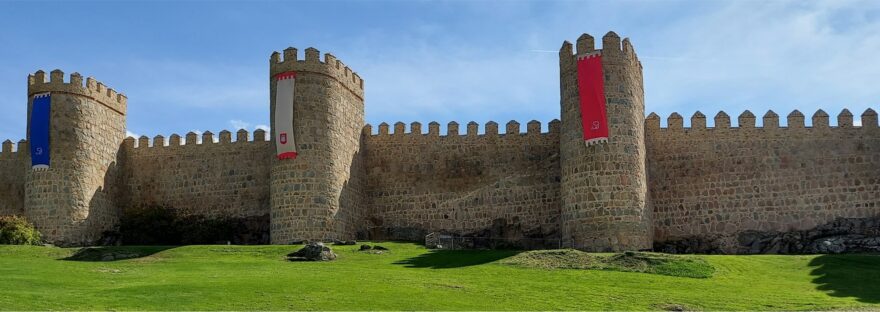
Since the beginning of time, the constant conflicts among human beings forced the development of protection measures, especially as they joined together to form communities. This led to the construction of fortresses and enclosed towns or cities. Therefore, only gates lead in and out of the city, the architectural element of greater prominence in this type of fortresses.
Continue reading “The gates of Toledo and San Vicente – Madrid”
In our tour of Catholic Europe, it has been very common to find many of the churches relatively close to each other. However, in our visit to Porto in Portugal, we find the so-called Twin Churches, separated by a few meters by the “Casa Escondida” (the hidden house).
Bordered by the “Avenida dos Aliados”, the old city meets the modern one at the “Praça da Liberdade” or Liberty Plaza. In what many consider as the center of the city of Oporto or Porto, surrounding the square are classic and modern buildings and, just a few steps away, the most emblematic historical places of the city.
The Sintra Villa , is located among the Sintra Hills Sierra , it is a UNESCO World Heritage Site. It’s history dates to the II century B.C. and was considered part of the Roman city of Olisspo, today known as Lisbon. It is granted the title of Municipality in 1154, a few years after its reconquest for Christianity by Alfonso I of Portugal.
Leaving behind the historic center of Braga, Portugal, we find at the end of a small hill the “Igreja do Carmo”, part of what was once the Convent of the Discalced Carmelites. The Convent was founded in 1635 by Brother José do Espírito Santo. Currently only the Church whose construction began in 1654 remains.
The “Igreja de São Roque” in Lisbon, Portugal, was originally a hermitage to keep relics of São Roque, Patron Victim of Plagues. In 1505, the city of Lisbon was infested by a plague, knowing that San Roque was the patron saint of the victims of plagues, the relics or remains of the Saint were obtained.
Walking towards the Douro River through the streets of Porto, suddenly we find the Plaza / Garden in honor of “Don Henrique de Avis y Lancaster”, son of Porto and better known as the Navigator. “Don Henrique” was the promoter of Portuguese policy for maritime explorations along the African coasts and the Atlantic Ocean; the era of Portuguese discoveries. In the center of this garden, a statue of the “Infante”, a work by Tomás Costa from 1894.
The Archbishop of Braga, Don Fray Agostinho de Jesus wanted to have a decent place to be buried. As a result, he ordered the construction of the Church of “Pópulo” in 1596 together with its Convent, destined for the religious order, the “Eremitas do San Agustín”. The name of the Church is derived from the Church of “Sanctae Mariae de Populo” in Rome, of great importance for the Order of Saint Augustine.
After strolling through the Jardim do Infante Dom Henrique, in Porto, Portugal, we headed towards the Igreja de São Francisco crossing the Rua de Ferreira Borges. As we climbed the stairs we could see the baroque facade of the Church with a rose window on the top and over the entrance a statue of Saint Francis. It was built between the seventeenth and eighteenth centuries.