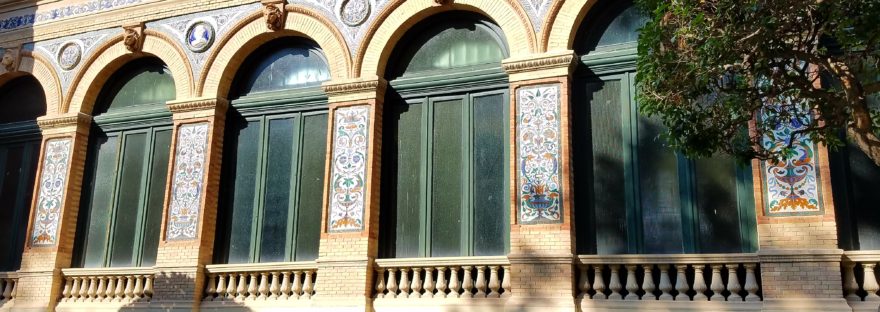
Our visit to Spain began in Madrid to later travel to Andalusia and return to Madrid. Therefore, we had a couple of days to explore the city.
Definitely, Madrid is a very cosmopolitan and modern city which holds many great treasures to visit. At the same time, it is the kind of place which can be visited a thousand times and there will always be something new to discover and new experiences to be lived. Continue reading “Finally in Madrid!”
 Inside the Mosque-Cathedral of Córdoba we will find the “Mihrab”.
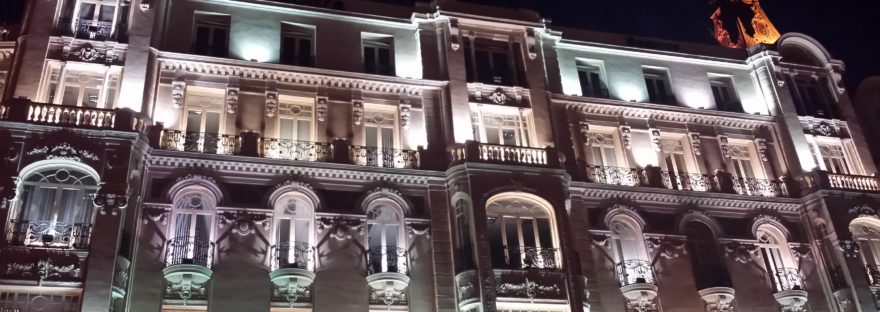
 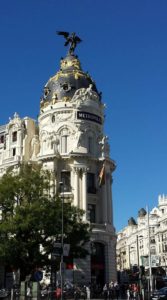 The Metropolis Building is considered to be the most emblematic of Madrid, Spain. Its actual physical address is 39 Alcalá Street, despite that many believe it is on the “Gran Via” (Grand Avenue). The building was designed by the famous French Architects Jules and Raymond Février by means of a contest. Various architectural styles were employed such as Roman, Beaux Arts and Neo-Roman. Its construction was ordered by the insurance company “La Unión y el Fénix” in 1907. Work was finally completed in 1910 under the eyes of the Spaniard Luis Esteve Fernández-Caballero. The building was inaugurated in 1911.
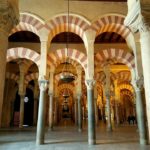 Upon entering the Mosque-Cathedral of Córdoba one might believe to have entered a forest, but instead of trees, one bows before one thousand three hundred columns of marble, jasper and granite.
 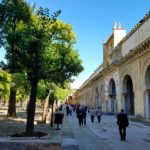 “A beautiful nursery of Orange Trees that catches one’s view upon entering that sacred temple”, this is how Fray Gregorio de Alfaro referred to the the Orange Grove or Garden of the Mosque – Cathedral of Córdoba in his writings towards the end of the XVI century.It’s name is derived from the 98 orange trees planted in rows.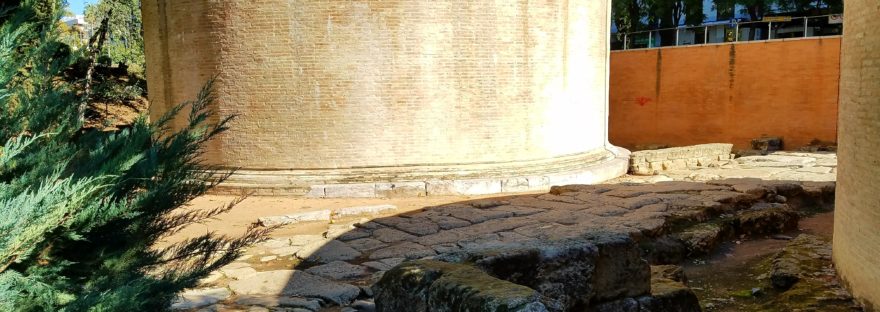
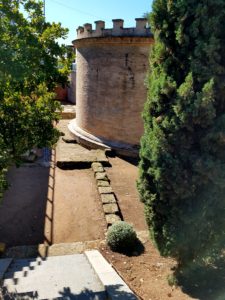 As we strolled through Córdoba, we unexpectedly encountered a large circular or cylindrical structure which turned out to be part of the Roman Mausoleums of Córdoba, a pleasant surprise. In researching the same, we discovered that this was of the most important funeral structures of the city built by the Romans and that they date back to the I Century. We observed that the same had be completely re-built and the burial hall containing Ash Urns as well as remains of its base, cornice and banisters . The Center for the Interpretation of the Funeral World is found therein and can be visited by appointment.
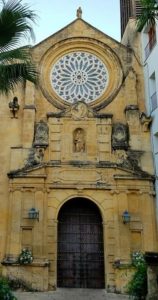 During our visit to Córdoba, we came across the Royal Church of Saint Paul, one of the most outstanding of the city’s center. It is among the first to be established by the Dominican Monks in Spain. It became an important house of study in which great missionaries were developed, such as Brother Francisco de Córdoba, First Martyr of the Evangelization in the Americas, Brother Tomás de San Martín, who placed the first stone of the University of Hispanola and founded the University of Lima (Peru) and Brother Jerónimo de Loaysa, first archbishop of Lime (Peru).